
Top 5 Security Mistakes Startups Make Before Series A
Most startups don't think about security until something goes wrong. By then, the damage - to data, reputation, and investor trust - is already done. Here are the five mistakes we see most often, and what you can do right now to fix them.
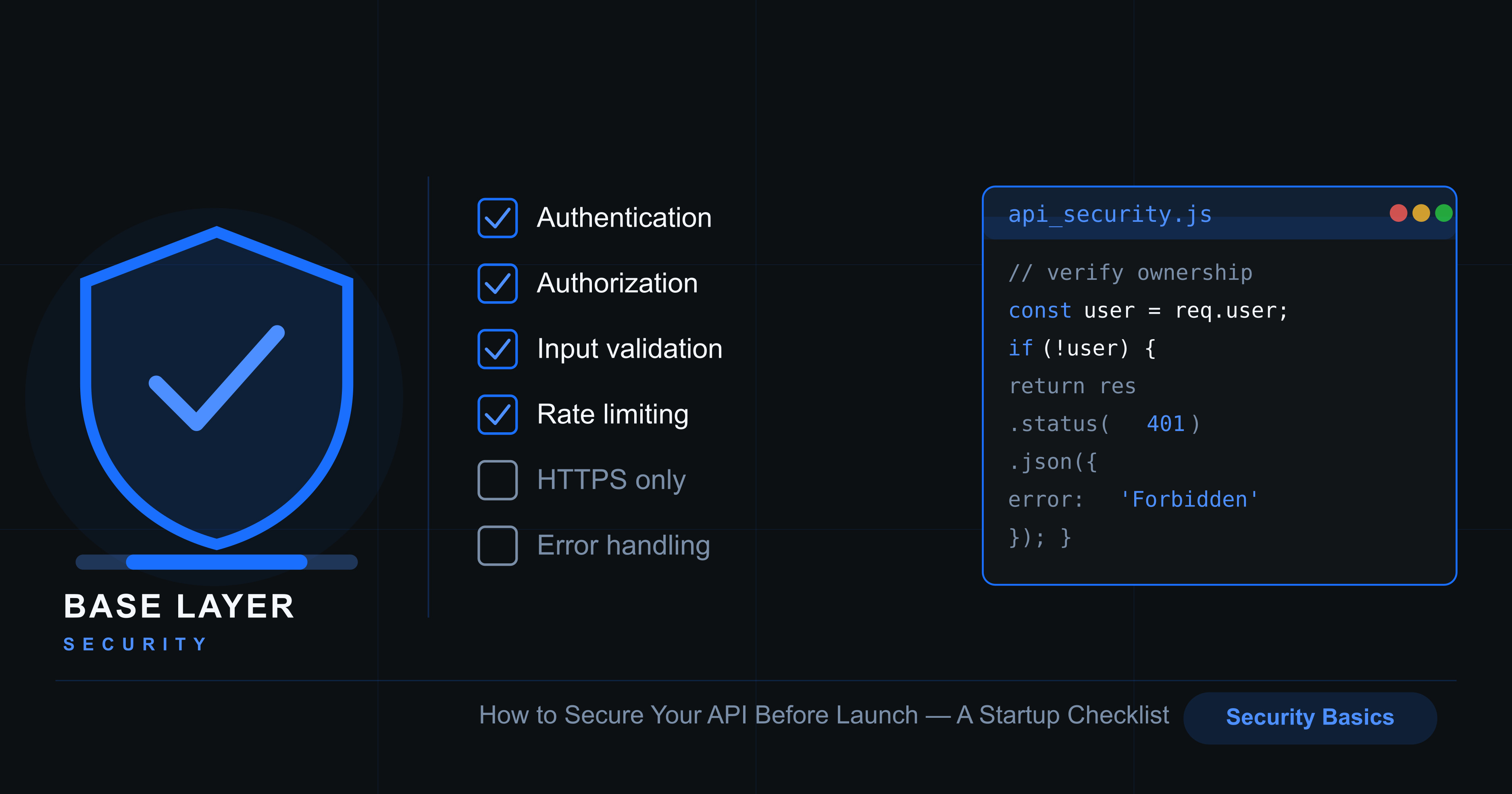
1. No Authentication Rate Limiting
Your login page is the front door. Without rate limiting, an attacker can attempt thousands of password combinations per minute - a basic brute-force attack that most frameworks don't block by default.
We regularly find startup login endpoints with no rate limiting, no account lockout, and no CAPTCHA. This means a single attacker with a password list can systematically try every combination until they get in.
Quick Fix
Add rate limiting to all auth endpoints (max 5 - 10 attempts per IP per minute). Use libraries like express-rate-limit for Node.js or Django's built-in throttling. Also enforce multi-factor authentication for admin accounts.
2. Secrets Hardcoded in the Codebase
API keys, database passwords, and private tokens committed directly into Git repositories is one of the most common and dangerous mistakes we find during assessments.
GitHub's public repositories are continuously scanned by automated tools. A leaked AWS key can result in a cloud bill of thousands of rupees within hours, or worse, a full data breach.
Quick Fix
Use environment variables and a secrets manager (AWS Secrets Manager, HashiCorp Vault, or even a simple .env file that's in your .gitignore). Run git-secrets or truffleHog on your existing repo to check for historical leaks.
3. Missing or Broken Access Controls
This is the #1 vulnerability in the OWASP Top 10 for good reason. It means users can access data or perform actions they shouldn't be allowed to - simply by changing an ID in the URL or API request.
A real example: change /api/invoices/1042 to /api/invoices/1041 and see another customer's invoice. We find this in roughly 60% of startup APIs we test.
Quick Fix
Always verify that the currently authenticated user has permission to access the requested resource - on every single API endpoint, not just the frontend. Never trust IDs sent from the client without server-side validation.
4. Overly Permissive Cloud IAM Roles
When setting up AWS or GCP quickly, it's tempting to attach broad policies like AdministratorAccess to service accounts just to make things work. These permissions almost never get reviewed or tightened later.
If that service account is ever compromised - through a leaked key, a server vulnerability, or a supply chain attack - an attacker inherits full access to your entire cloud environment.
Quick Fix
Apply the principle of least privilege: each service should only have the exact permissions it needs. Audit your IAM roles quarterly. Use AWS IAM Access Analyzer to automatically flag overly permissive policies.
5. No Security Testing Before Launch
Most startups ship features fast and think about security later. But fixing a vulnerability after launch - especially after a breach - costs 10 - 100x more than catching it before go-live.
Investors doing due diligence before Series A increasingly ask for evidence of security testing. A basic VAPT report can be the difference between a smooth fundraise and a difficult conversation.
Quick Fix
Run a basic VAPT (Vulnerability Assessment and Penetration Test) on your core application before launch and before any major funding round. Even a focused one-week assessment catches the majority of critical issues.
The Bottom Line
Security doesn't have to be expensive or complicated at the startup stage. Fixing these five issues costs very little in time and money - but ignoring them can cost everything.
If you're not sure where your application stands, we offer a free initial assessment call to walk through your stack and identify the highest-risk areas.
Not sure if your startup is vulnerable?
We offer a free 30-minute security assessment call - no commitment, no jargon.
Book a Free Assessment